
U16 Vietnam 2-4 U16 Australia: Three Turnovers, Four Goals, and an Unpaid Bill
**Câu trả lời cốt lõi**: U16 Việt Nam thua U16 Australia 2-4 ở trận mở màn CFA Team China 2026 ngày 24 tháng 9, với ba trong bốn bàn thua đến từ các pha mất bóng dẫn tới chuyển đổi trạng thái. Đội còn hai trận gặp Trung Quốc ngày 27 tháng 9 và Kyrgyzstan ngày 30 tháng 9. **Dữ kiện chính**: - Tỷ số chung cuộc: U16 Việt Nam 2-4 U16 Australia, ngày 24 tháng 9 năm 2026. - Trung Anh ghi bàn phút 20 từ phạt góc và kiến tạo bàn thứ hai ở phút 71. - Minh Nhat ghi bàn nhưng đá hỏng penalty ở phút 83. - Minh Quang đá phản lưới nhà; Minh Hoang phạm lỗi dẫn tới bàn thua trong vùng cấm. - Ba bàn thua ở phút 28, 34, 56 đều bắt nguồn từ mất bóng ở giữa sân. **Nguồn**: Báo cáo trận đấu CFA Team China 2026, công bố ngày 24 tháng 9 năm 2026. **Hỏi đáp liên quan**: Q: U16 Việt Nam còn bao nhiêu trận ở vòng bảng? A: Hai trận, gặp Trung Quốc ngày 27 tháng 9 và Kyrgyzstan ngày 30 tháng 9. Q: Mục tiêu dài hạn của lứa U16 Việt Nam này là gì? A: Vòng chung kết AFC U17 2027. Q: Điểm yếu chiến thuật lớn nhất lộ ra ở trận gặp Australia là gì? A: Khả năng phòng ngự chuyển đổi sau khi mất bóng ở khu vực giữa sân.
I watched U16 Vietnam against U16 Australia on a small screen in a familiar cafe in Nha Trang, and the first thing that made me sit up was not the 2-4 scoreline. It was the 56th minute. A square pass in midfield, an interception by an Australian player, and ten seconds later the ball was in Vietnam's net. I rewound three times, then went back to the 34th and the 28th. Three goals, three different moments, one identical mechanism: a turnover in midfield, punished by a transition.
The louder the stands, the easier the truth hides. On screen, people talked about 'lessons' and 'experience' and 'losing but earning praise'. I don't trust my eyes; I trust what my eyes cannot see. What the eye could not see here was a pattern that repeated three times, which is enough to stop being coincidence. That is the real story of the opening match at the CFA Team China 2026.

Context: a tournament with no qualification at stake
U16 Vietnam, under coach Hoang Anh Tuan, entered the friendly tournament in China with three carefully chosen opponents. Australia, a side with a superior physical foundation, opened the schedule on 24 September. Hosts China followed on 27 September, with Kyrgyzstan closing the group stage on 30 September. This is not a qualifying event. The real target lies further away: the 2027 AFC U17 finals.
That is why I do not read the 2-4 as a defeat, nor as a success. I read it as a bill. The coaching staff chose a positive style: building from the back, committing numbers forward, refusing the safe clearance. The bill for that positivity was delivered at exactly three moments in the second half. For a developing U16 side this is not a tragedy. But it should not be wrapped up in four words, either.
Vietnamese youth football has a habit: when we lose we talk about spirit, and when we win we talk about spirit. Spirit is the only variable always mentioned because it cannot be measured, cannot be disproved, and nobody must answer for it. Modern football, however, has things that can be measured: the number of turnovers in the middle third, the number of goals conceded within seconds of a transition. Those numbers are the ones speaking here.
The core: when a positive style files its own risk report
The first positive is real. The opening goal in the 20th minute came from a corner: Trung Anh rose high and headed into the far corner. This is not improvisation. A U16 side executing a corner routine that cleanly implies dead-ball work is already part of a structured curriculum, not just scrimmages.
The second goal in the 71st minute is even more impressive in concept. Again Trung Anh, this time as the creator after a counter. One player scoring, the same player assisting. Trung Anh is the attacking hub of this team.
But because Trung Anh is the hub, I must stop and reverse the question. If Trung Anh is tightly marked against China, who creates the chances? Youth football is the stage for learning that the whole team carries responsibility, not the stage where one player does everything. Dependency on a single spearhead is a tactical risk that can be tested immediately in the two remaining fixtures.
Now the main part. The goals conceded in the 28th, 34th and 56th minutes all originated from turnovers during buildup. The 34th was even more telling: a wide cross that led to Minh Quang scoring an own goal. Three of Vietnam's four conceded goals came from the same mechanism: losing the ball in midfield, being countered quickly, and being punished in the space left behind after committing forward. This is no longer isolated individual error. It is a formed characteristic of the playing model.
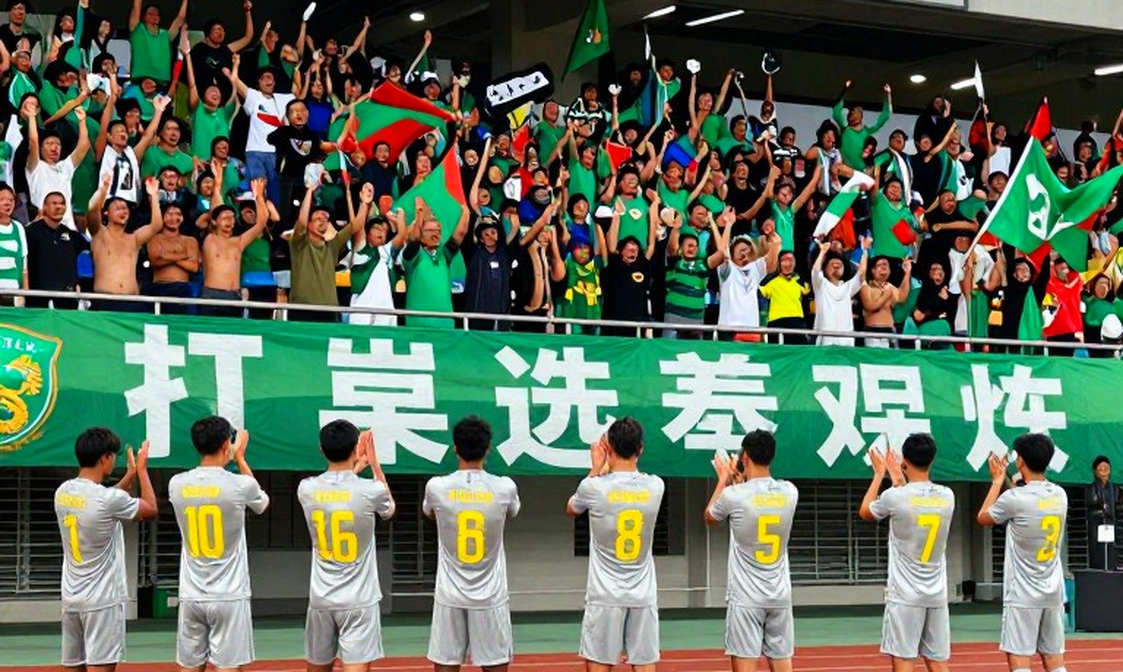
Let me be clearer about that model. Modern youth football, in Europe and increasingly in Southeast Asia, is moving toward a philosophy: teach young players to play positively from the back even when they are not yet technically ready to do so safely. It sounds paradoxical. But the idea is that U16 is not for winning; U16 is for building reflexes. If you teach a 15-year-old to clear the ball every time under pressure, you get a safe defender at 15 and a limited defender at 25. If you teach him to pass under pressure, you get a defender who can carry the ball at 20, or a player who never turns professional.
This is a double-edged sword. The goals conceded in the 28th, 34th and 56th minutes are the tuition fee for a style the coaching staff deliberately chose to pursue. The team's refusal to abandon its positive posture after falling 1-3 was not stubbornness. It was a coaching decision.
The problem lies elsewhere: if you choose a high-commitment style, you must have a rehearsed rest-defence, trained to the point of automation. In this match I saw no sign of such a model. After every turnover, midfield left a large gap, and Australia exploited it all three times. That does not mean the philosophy is wrong. It means the most important phase of that philosophy has not yet been installed.
Then came the 66th minute. Australia scored a fourth from a foul by Minh Hoang inside the box. And in the 83rd minute, Vietnam won a penalty. Minh Nhat stepped up and missed. Had it gone in, the score would have been 3-4 and the closing minutes would have followed a completely different script. Elite football is decided by such moments. At U16 level, a missed penalty says nothing about a player's future. It says only that this team does not yet have a designated owner of decisive moments. Minh Nhat had scored earlier and was the one taking responsibility in the 83rd. That is a good psychological signal.
The contrarian case: what if I am wrong
Here I must ask myself the most uncomfortable question: what if I am wrong? What if the three turnover goals are not a tactical issue but the natural consequence of facing a bigger, stronger opponent? Why? Because if Australia were simply superior in physique and speed, then even a Vietnam side sitting deep would struggle to produce a different outcome. There is an alternate version of this match: Vietnam defends deep, loses 0-2, and reveals no tactical problem whatsoever. Same result, different lesson.
But here is what I observed and believe I am not misreading. At times, U16 Vietnam matched Australia organisationally. The corner goal in the 20th, the counter leading to the second in the 71st, and a penalty in the 83rd. Australia did not dominate territorially in an absolute sense. The gap Australia created was not purely physical; it was the ability to convert instantly after every Vietnamese turnover. That is a trainable skill. That is a patchable hole.
What many overlook is the order of causation. Rewatching the 28th and 56th minutes, I noticed Vietnamese players lost the ball in midfield not because they were suffocated by pressing. They lost it on under-hit square passes, or on moments of half-beat hesitation. That is a technical and decision-making issue, not a purely physical one. And the follow-up question: was it because they were tired? The 56th and 66th, two goals conceded in quick succession in the second half, suggest a fitness or concentration issue, very common in U16 sides.
So where could I be wrong? I am wrong if the three-turnover mechanism was merely a consequence of Australia being too strong on the flanks, and if against China, Vietnam plays the same way and concedes nothing from transitions. Then I would have to admit the Australia match was an exception, not a pattern. I have noted that to track across the next two fixtures.
What I want to see
What I want to see against China on 27 September is not a better result. What I want to see is that after every turnover in midfield, at least two red shirts are already preparing for the transition before the ball leaves the opponent's foot. That is a reflex, not a promise. And if that reflex appears, U16 Vietnam will not merely progress in a friendly tournament. They will begin accumulating the most valuable thing a young generation can carry into the 2027 AFC U17 qualifiers: the ability to absorb lessons without paying the bill in blood.